Curriculum
Principles and practical resources for designing and developing medical education curricula.
Outcome-based Education
Integrated Curriculum
The Integration Ladder
Curriculum integration is a continuum, with a fully integrated curriculum at one end and a subject-based curriculum at the other, and intermediate steps in between. In 2000, Prof. Ronald Harden described an eleven-step integration ladder in Medical Education, spanning isolation at one extreme to trans-disciplinary fusion at the other.
The Integration Ladder, explained.
SPICES Model
In the SPICES curriculum model described by Harden and colleagues in 1984, integration is a strategy along a continuum — full integration at one end, discipline- or specialty-based teaching at the other, with intermediate steps between.
Horizontal integration works across disciplines within a fixed period of time. Vertical integration works across time, breaking down the traditional barrier between basic and clinical sciences. Spiral integration combines both, uniting disciplines and time.
Harden's integration ladder offers 11 points on this continuum, usable as a tool to plan, implement and evaluate a curriculum:
- Isolation (fragmentation, anarchy)
- Awareness
- Harmonization (connection, consultation)
- Nesting (infusion)
- Temporal co-ordination (parallel or concurrent teaching)
- Sharing (joint teaching)
- Correlation (concomitant or democratic programme)
- Complementary (mixed programmes)
- Multi-disciplinary (webbed, contributory)
- Inter-disciplinary (monolithic)
- Trans-disciplinary (fusion, immersion, authentic)
Based on their experience at UiTM, Malaysia, Malik & Malik describe twelve tips for developing an integrated curriculum while avoiding common mistakes:
- Train staff members
- Decide the scope of integration
- Choose the level of integration
- Pursue both vertical and horizontal integration
- Establish working groups and clarify responsibilities
- Determine learning outcomes
- Identify content (knowledge, skills, attitude)
- Create themes
- Prepare a comprehensive timetable
- Select assessment tools
- Communicate with students and staff
- Commit to re-evaluation and revision
Integration ultimately has to take place in the mind of the student, while the teacher facilitates the links the student forms and the curriculum provides opportunities for integrated learning.
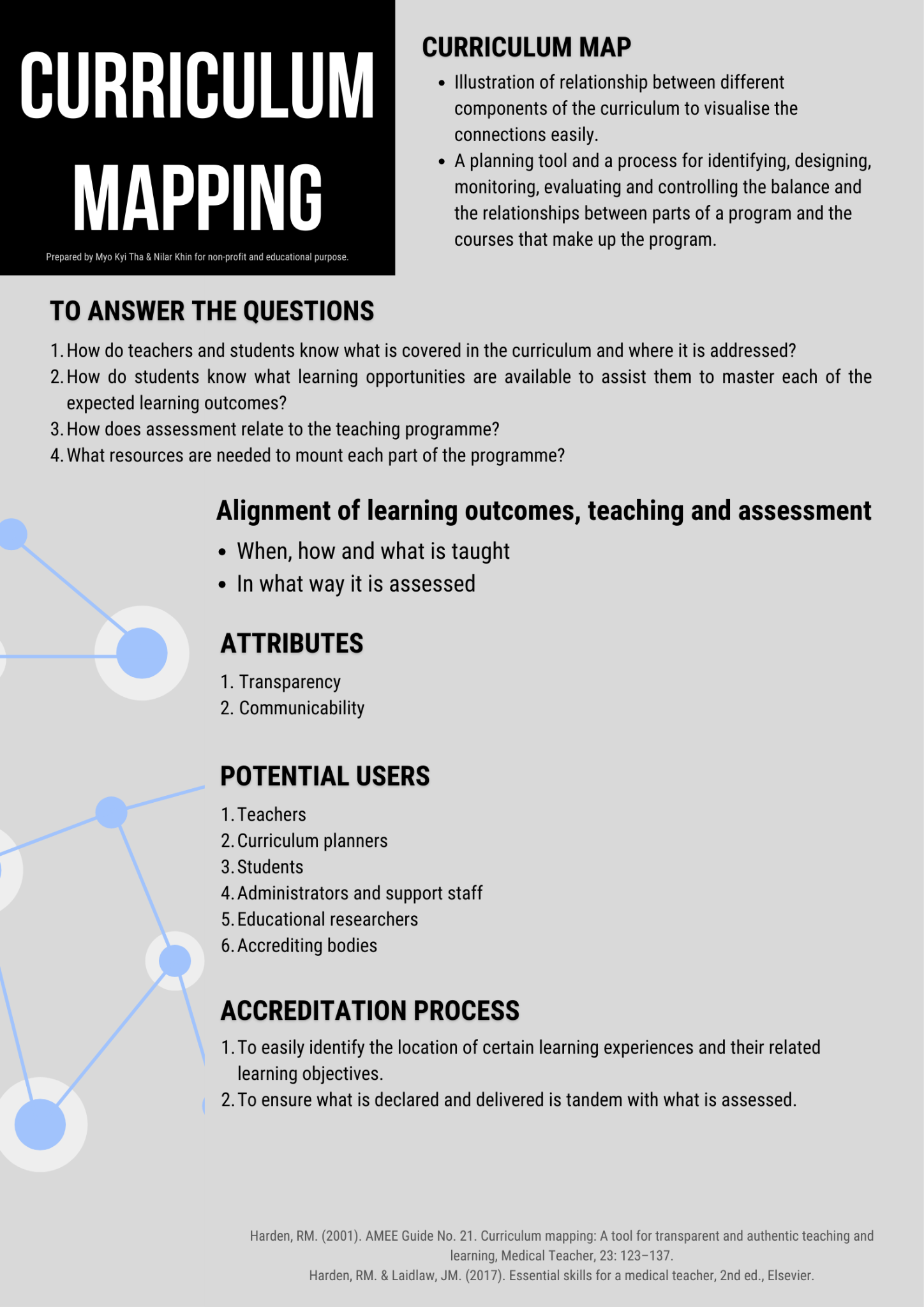
Curriculum Mapping
Curriculum mapping indexes or diagrams a curriculum to identify academic gaps, redundancies and misalignments, improving the overall coherence and effectiveness of a course of study. A curriculum map describes what is taught, how, when, and how well it matches what is assessed — making it a powerful curriculum-management tool.
In AMEE Guide 21, Prof. Ronald Harden explains curriculum mapping and its four core windows: learning outcomes, content, learning opportunities, and assessment. Extended further, a curriculum can be viewed through ten windows:
- Expected learning outcomes
- Curriculum content / areas of expertise
- Student assessment
- Learning opportunities
- Learning location
- Learning resources
- Timetable
- Staff
- Curriculum management
- Students
Curriculum mapping is an ongoing process — educators continually refine every aspect of the curriculum to improve student learning.